01Society and IdentityEditorial essay
The Question of Contemporary Syrian Identity
What does it mean for Syrian culture to remain alive under conditions of profound change? The answer cannot be reduced to a visual style, a set of inherited customs or a fixed account of national identity. It begins with examining how people live, work, remember, adapt and create.
- Byline
- Syrian Society Foundation — Editorial
- Reading time
- 4 min read
An editorial working perspective from the initiative. It is not a summary of completed research.
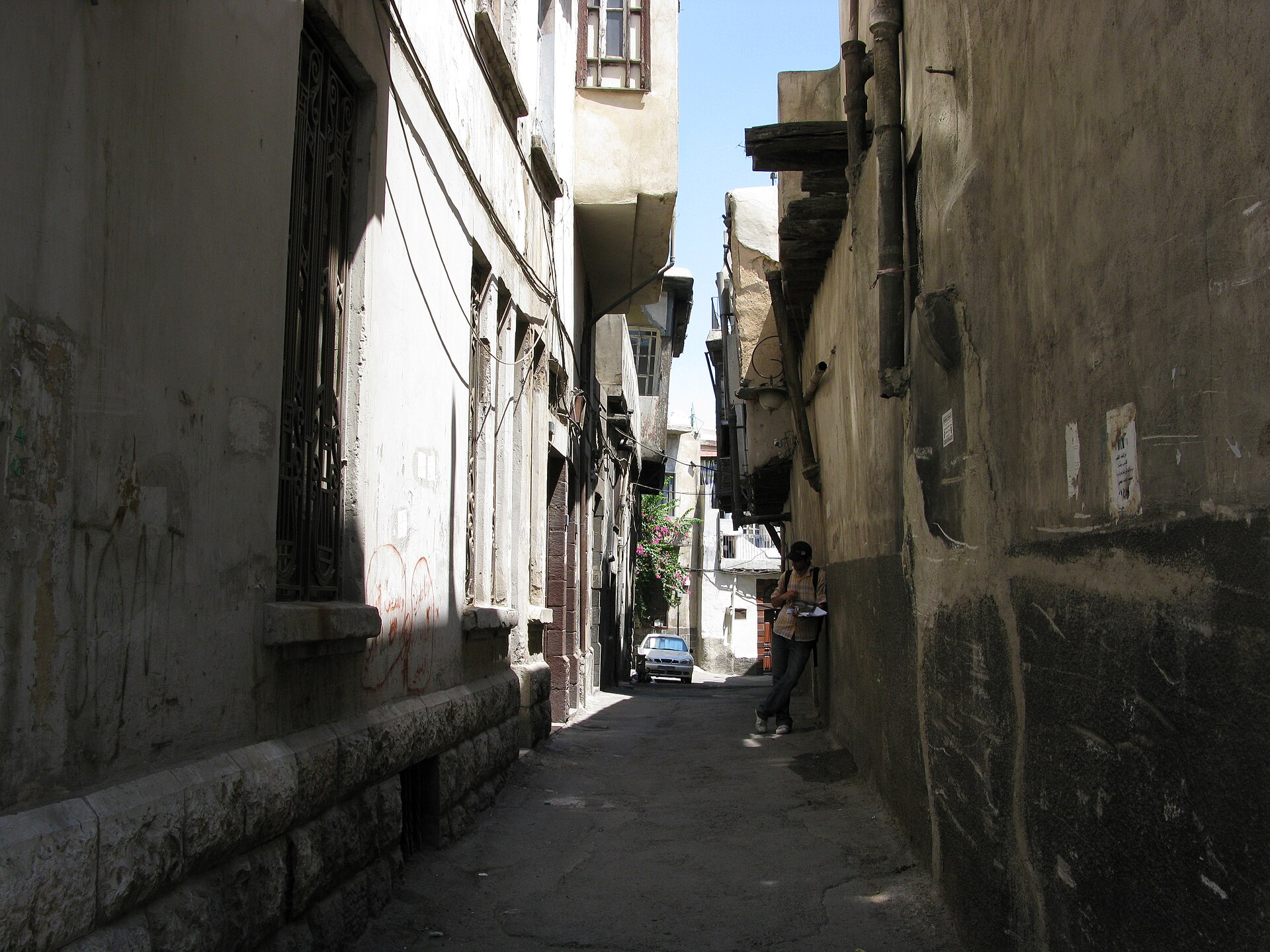
Questions about identity tend to arrive with a demand for answers. In moments of upheaval, people look for something stable to hold on to, and a single description of who “we” are can seem to offer it. Such descriptions are rarely neutral. They decide which experiences count as typical, which regions or communities stand in for the whole, and which forms of life are treated as deviations.
Identity as practice
A more useful starting point may be to treat identity as something people do rather than something they possess. It appears in how a family organises a household, how a neighbourhood uses a street, how a craftsperson judges a material, how someone switches between dialects depending on who is listening. These practices are not frozen. They change with migration, prices, technology, schooling and the arrival of new neighbours.
Looking at identity this way does not dissolve it into nothing. Shared references exist: food, music, idioms, ways of hosting, ways of arguing. But shared references are different from a shared definition. Two people can recognise the same proverb and draw opposite conclusions from it. A living culture includes that disagreement.
The pull of the visible
When identity is discussed publicly, it is often represented by its most visible surfaces: patterns, architectural details, costumes, a handful of dishes. These surfaces matter, yet they can become a kind of shorthand that replaces attention to how people actually live now. A café decorated with inherited motifs may say less about contemporary Syrian life than the way its staff negotiate wages, or the way its customers divide a bill.
This is a working hypothesis rather than a finding: the more a culture is reduced to visible symbols, the harder it becomes to see the knowledge embedded in ordinary routines.
Different vantage points
Syrians in different cities, rural areas and countries hold different pieces of the picture. Someone who has stayed through years of hardship and someone who has built a life abroad may both speak with authority, and both may be partial. Generations differ too. What one generation experiences as loss, another may experience as the normal texture of life.
Any serious inquiry has to make room for these differences without ranking them in advance. That means listening for experiences that rarely appear in public narratives, including those that complicate comfortable stories.
Who is entitled to describe?
Behind every account of identity sits a prior question: who has the standing to describe a society, and on whose behalf? States, religious institutions, political movements, international organisations, artists and families all produce descriptions of what it means to be Syrian. Each has reasons, interests and blind spots. A description offered from a capital city may sound general and still be local; a description offered by those who left may sound distant and still be accurate about things insiders no longer notice.
This suggests a working proposition: an account of identity is more trustworthy when it shows where it is speaking from, and what it cannot see from there. Such an account would be less confident, and more useful.
Memory, loss and the right to change
Recent years have produced loss on a scale that makes questions of identity painful rather than academic. Places, people, objects and routines have disappeared. It is understandable that memory becomes protective, and that change is felt as a further loss. Yet a culture that only remembers risks turning its members into custodians rather than participants.
The difficult question is whether one can honour what was lost while allowing the living to change: to speak differently, marry differently, work differently, build differently, and still be recognised as belonging. We do not think there is a single answer. We do think the question deserves to be asked openly, in villages and suburbs as well as in capitals and diaspora cities.
Limits of this argument
This essay leans on observation and reasoning, not on completed fieldwork. Its examples are general. It may underestimate how much people value stable symbols in times of insecurity, and how practices themselves can exclude. Testing it would require listening to people across regions, generations, classes and countries, and being prepared to revise it.
What this initiative is asking
We are not trying to establish who is authentically Syrian. We are interested in narrower, more answerable questions:
- Which everyday practices carry knowledge that is rarely recognised as culture?
- How do people describe belonging when they are not asked to perform it?
- Where do shared references create connection, and where do they hide difference?
These questions do not lead to a single portrait. They may lead to something more useful: a more precise vocabulary for talking about change, and a clearer sense of what people themselves want to carry forward.
Tags: identity, belonging, everyday life